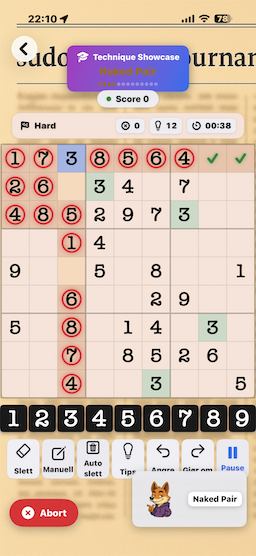
What is a Naked Pair?
A Naked Pair occurs when two cells in the same unit (row, column, or box) contain exactly the same two candidates and no other candidates. These two cells "claim" those two numbers, allowing you to eliminate them from all other cells in that unit.
The term "naked" means the pair is clearly visible – both cells show only those two candidates with nothing else hiding them.
Why Does This Work?
Consider two cells that both contain only candidates {3, 7}. One of these cells must be 3, and the other must be 7. We don't know which is which yet, but we know for certain that 3 and 7 are "reserved" for these two cells. No other cell in the same unit can contain 3 or 7.
How to Find Naked Pairs
Step-by-Step Process:
- Scan for bi-value cells: Look for cells with exactly two candidates
- Find matching pairs: Check if another cell in the same unit has the identical two candidates
- Verify the match: Both cells must have ONLY those two candidates (nothing else)
- Make eliminations: Remove both candidates from all other cells in that unit
- Check all shared units: If the pair shares multiple units (e.g., same row AND same box), eliminate from both
Example Analysis
Finding a Naked Pair in a Row
Imagine row 5 has these candidates in its empty cells:
- Cell A: {2, 5}
- Cell B: {1, 2, 5, 8}
- Cell C: {2, 5}
- Cell D: {1, 8}
Cells A and C form a Naked Pair! Both contain only {2, 5}.
Elimination: Remove 2 and 5 from Cell B, leaving it with {1, 8}.
Common Mistakes to Avoid
- Extra candidates: Both cells must have EXACTLY two candidates – if one has three, it's not a Naked Pair
- Different units: The cells must share a unit (row, column, or box) for eliminations to apply
- Incomplete eliminations: Remember to eliminate from ALL other cells in the shared unit(s)
- Confusing with Hidden Pairs: Naked Pairs are visible; Hidden Pairs have extra candidates in the cells
Naked Pairs in Different Units
Row Naked Pair
Two cells in the same row with identical bi-value candidates. Eliminate from other cells in that row.
Column Naked Pair
Two cells in the same column with identical bi-value candidates. Eliminate from other cells in that column.
Box Naked Pair
Two cells in the same 3×3 box with identical bi-value candidates. Eliminate from other cells in that box.
Bonus: Overlapping Units
When a Naked Pair exists in cells that share multiple units (e.g., both in the same row AND the same box), you can make eliminations in BOTH units. This makes the technique even more powerful!
Practice Strategy
Building Your Skills:
- Mark all candidates: Naked Pairs are much easier to spot with complete pencil marks
- Focus on bi-value cells: Cells with exactly two candidates are your starting points
- Scan systematically: Check each bi-value cell against others in its row, column, and box
- Verify before eliminating: Double-check that both cells have ONLY those two candidates
Ready to Practice?
Download SudokuWorldTournament and master Naked Pairs with real-time technique recognition!
Download Free on App Store