👯‍♂️ Naked Triple Technique

Three cells, three candidates, maximum eliminations

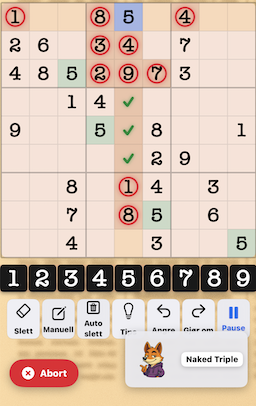
Naked Triple pattern example in Sudoku

What is a Naked Triple?

A Naked Triple is a powerful intermediate Sudoku technique that extends the Naked Pair concept. It occurs when three cells in the same house (row, column, or box) contain only candidates from a set of three numbers, with no other candidates present.

Because these three cells must contain these three numbers (one in each cell), you can eliminate those three candidates from all other cells in the same house. The technique is called "naked" because the candidates are clearly visible – not hidden among other candidates.

The Core Principle

The logic behind Naked Triples is elegant: if three cells in a house can only contain three specific numbers, then those three numbers must go in those three cells. This means no other cell in that house can contain any of those three numbers.

The Naked Triple Rule: When three cells in a house contain only candidates from a set of three numbers {A, B, C}, those candidates can be eliminated from all other cells in that house.

Important: Not every cell needs to contain all three candidates. Valid Naked Triple combinations include:

Advertisement

How to Identify a Naked Triple

Step-by-Step Process:

  1. Scan for small candidate cells – Look for cells with two or three candidates
  2. Identify potential triples – Find three cells in the same house whose combined candidates form exactly three numbers
  3. Verify the pattern – Ensure no cell contains candidates outside the triple set
  4. Eliminate – Remove all three candidates from other cells in that house
  5. Check all houses – The triple might affect a row, column, AND box simultaneously

Analysing the Example

Reading the Diagram

In the example image, you can see a Naked Triple highlighted:

  • The triple cells: Three cells containing only candidates from a set of three numbers
  • The candidates: The three numbers that form the naked triple
  • Eliminations: Other cells in the same house where these candidates are removed

Notice how the three cells "claim" their candidates, preventing them from appearing elsewhere in the house.

Worked Example

Finding a Naked Triple in a Row

Setup: In Row 3, we have:

  • Cell R3C1: {1, 4}
  • Cell R3C2: {2, 5, 7}
  • Cell R3C3: {1, 4, 9}
  • Cell R3C4: {4, 9}
  • Cell R3C5: {2, 4, 5}
  • Cell R3C6: {1, 2, 9}
  • Cell R3C7: {5, 7}
  • Cell R3C8: {2, 7}
  • Cell R3C9: {3}

Analysis: Cells R3C1, R3C3, and R3C4 contain only candidates from {1, 4, 9}:

  • R3C1: {1, 4} ✓ (subset of {1, 4, 9})
  • R3C3: {1, 4, 9} ✓ (exactly {1, 4, 9})
  • R3C4: {4, 9} ✓ (subset of {1, 4, 9})

Elimination: Remove 1, 4, and 9 from all other cells in Row 3:

  • R3C5: {2, 4, 5} → {2, 5}
  • R3C6: {1, 2, 9} → {2}

Result: R3C6 becomes a Naked Single with value 2!

Key Insight: Naked Triples often create chain reactions. After eliminating candidates, check if new Singles, Pairs, or even more Triples have appeared.
Advertisement

Naked Triple vs Hidden Triple

Understanding the difference between Naked and Hidden Triples is crucial:

Naked Triple

  • Three cells contain ONLY candidates from a set of three numbers
  • Easier to spot – the cells stand out with limited candidates
  • Eliminates from OTHER cells in the house

Hidden Triple

  • Three candidates appear in ONLY three cells
  • Harder to spot – hidden among other candidates in those cells
  • Eliminates OTHER candidates from those three cells

Common Naked Triple Patterns

Pattern Variations

Naked Triples come in several forms. All are equally valid:

Full Triple:

  • Cell 1: {2, 5, 8}
  • Cell 2: {2, 5, 8}
  • Cell 3: {2, 5, 8}

Partial Triple (most common):

  • Cell 1: {2, 5}
  • Cell 2: {5, 8}
  • Cell 3: {2, 8}

Mixed Triple:

  • Cell 1: {2, 5, 8}
  • Cell 2: {2, 5}
  • Cell 3: {5, 8}

Common Mistakes to Avoid

  • Extra candidates: All three cells must contain ONLY candidates from the triple set
  • Wrong count: You need exactly three cells with exactly three combined candidates
  • Missing candidates: The three cells together must cover all three candidates (though not each cell individually)
  • Wrong house: Only eliminate from cells in the SAME house as the triple
  • Eliminating the triple: Never eliminate candidates from the triple cells themselves
Advertisement

The Subset Family

Naked Triple is part of a family of "naked subset" techniques:

The principle is the same: N cells with N candidates "claim" those candidates for themselves.

When to Look for Naked Triples

Optimal Conditions:

  • After finding all Singles and Pairs
  • When you see multiple cells with two or three candidates
  • In houses with several solved cells (fewer candidates to check)
  • When progress has stalled with simpler techniques
  • After making eliminations that create new small-candidate cells

Practice Tips

Building Recognition Skills:

  1. Start with Pairs: Master Naked Pairs first – Triples use the same logic
  2. Look for bi-value cells: Cells with exactly two candidates are often part of triples
  3. Check combinations: When you find two cells that could be a pair, look for a third cell
  4. Use pencil marks: Good notation makes triples much easier to spot
  5. Practice systematically: Check each house methodically
Pro Tip: In SudokuWorldTournament, using Naked Triples earns significant bonus points! The app recognises when you apply this technique and rewards your logical solving approach with extra score.