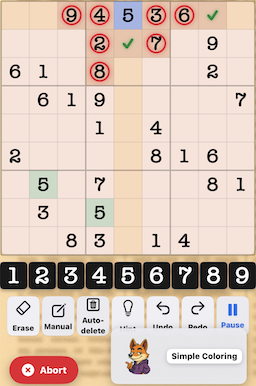
What is Simple Colouring?
Simple Colouring is a technique that uses two colours to mark alternating possibilities for a single candidate. By following chains of "conjugate pairs" (cells where a candidate appears exactly twice in a unit), you can identify contradictions or make eliminations.
Think of it as painting cells with two colours – if one colour is "true," the other must be "false."
Understanding Conjugate Pairs
A conjugate pair exists when a candidate appears in exactly two cells within a unit (row, column, or box). These two cells have a special relationship: one MUST contain the candidate, and the other MUST NOT.
Blue = True
If this cell contains the candidate...
Red = False
...then this cell cannot contain it
How Simple Colouring Works
Step-by-Step Process:
- Choose a candidate: Pick a number that appears in several conjugate pairs
- Start colouring: Pick any cell with the candidate and colour it Blue
- Follow conjugate pairs: The paired cell gets the opposite colour (Red)
- Continue the chain: From each coloured cell, find more conjugate pairs and alternate colours
- Look for conclusions: Check for contradictions or elimination opportunities
Two Types of Conclusions
Type 1: Colour Contradiction
Two cells of the same colour see each other (share a unit)
Result: That colour is FALSE – eliminate the candidate from ALL cells of that colour
Type 2: Colour Trap
An uncoloured cell sees both colours
Result: Eliminate the candidate from that uncoloured cell
Type 1: Colour Contradiction
Finding a Contradiction
If two Blue cells end up in the same row, column, or box, we have a contradiction. Both cannot be true (a number can't appear twice in a unit).
Conclusion: Blue is false. Remove the candidate from ALL Blue cells.
Bonus: Red must be true – you can place the candidate in all Red cells!
Type 2: Colour Trap
Finding a Trap
If an uncoloured cell can "see" both a Blue cell and a Red cell (shares units with both), the candidate can be eliminated from that cell.
Logic: Either Blue is true OR Red is true. Either way, the uncoloured cell cannot have the candidate.
Building the Colour Chain
Example Chain
- Cell R1C3 has candidate 5 – colour it Blue
- R1C3 forms a conjugate pair with R1C7 in row 1 – colour R1C7 Red
- R1C7 forms a conjugate pair with R4C7 in column 7 – colour R4C7 Blue
- R4C7 forms a conjugate pair with R4C2 in row 4 – colour R4C2 Red
- Continue until no more connections...
Tips for Success
- Choose good candidates: Look for numbers with many conjugate pairs across the grid
- Be systematic: Follow every conjugate pair connection from each coloured cell
- Check all units: Conjugate pairs can exist in rows, columns, OR boxes
- Look for both conclusion types: Check for contradictions AND traps
Ready to Practice?
Download SudokuWorldTournament and master Simple Colouring!
Download Free on App Store