🔢 Hidden Triple Technique

Find three candidates hiding among the crowd

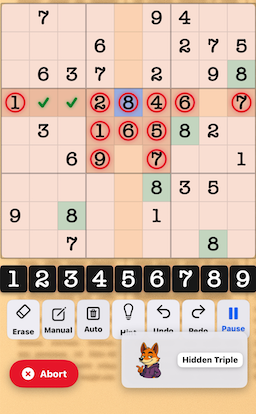
Hidden Triple pattern example in Sudoku

What is a Hidden Triple?

A Hidden Triple (also called Hidden Triplet) is an intermediate Sudoku technique where three candidates appear together in exactly three cells within a house (row, column, or box), but these cells also contain other candidates that obscure the pattern.

Unlike a Naked Triple where the three cells contain only the three candidates, a Hidden Triple is "hidden" because additional candidates are present in those cells. Once identified, you can eliminate all other candidates from those three cells.

The Core Principle

The Hidden Triple is based on the pigeonhole principle: if three specific candidates can only appear in three specific cells within a house, then those three cells must contain those three candidates – regardless of what other candidates are currently pencil-marked there.

The Hidden Triple Rule: When three candidates appear only in three cells within a house, those three cells must contain those three candidates. All other candidates in those cells can be eliminated.

This is the opposite of a Naked Triple:

Advertisement

How to Identify a Hidden Triple

Step-by-Step Process:

  1. Choose a house to analyse (row, column, or box)
  2. List all candidates and note which cells contain each candidate
  3. Look for three candidates that appear only in three cells (combined)
  4. Verify the pattern – each of the three candidates must appear in at least one of the three cells
  5. Eliminate extras – remove all other candidates from those three cells
  6. Result – you now have a Naked Triple that may enable further eliminations

Naked vs Hidden Triple

Naked Triple

What you see: Three cells containing only candidates from {A, B, C}

What you eliminate: A, B, C from all other cells in the house

Easier to spot: The cells stand out because they have few candidates

Hidden Triple

What you see: Three candidates {A, B, C} appearing only in three cells

What you eliminate: All other candidates from those three cells

Harder to spot: Extra candidates in the cells hide the pattern

Key Insight: After applying a Hidden Triple, the three cells become a Naked Triple! This often leads to additional eliminations in the same house.
Advertisement

Analysing the Example

Reading the Diagram

In the example image from SudokuWorldTournament, we can see a Hidden Triple pattern in Row 4:

The Pattern Components:

  • Row 4 (pink highlighted): This is the house where the Hidden Triple is found
  • The three candidates: Looking at the circled numbers, we can identify candidates that appear only in specific cells
  • R4C1: Contains candidate 1 (circled in red)
  • R4C4: Contains candidate 2 (circled)
  • R4C5: Contains candidate 8 (blue highlighted cell) and 4 (circled)
  • R4C6: Contains candidates 4 and 6 (both circled)
  • R4C9: Contains candidate 7 (circled)

The Hidden Triple:

The candidates 3, 5, and 9 (or similar combination based on the puzzle state) appear ONLY in three specific cells within Row 4. These candidates are "hidden" because those cells also contain other candidates.

The Elimination:

  • Green checkmarks (✓): R4C2 and R4C3 show where eliminations have been made
  • Green cells: Indicate cells affected by the technique
  • Result: All candidates EXCEPT the hidden triple candidates are removed from the three cells

The fox mascot at the bottom confirms: "Hidden Triple" – showing that the app has detected this intermediate-level pattern. After applying this technique, the three cells become a Naked Triple, potentially enabling further eliminations.

Worked Example

Finding a Hidden Triple in a Row

Setup: Consider Row 5 with the following candidates:

  • Cell 1: {1, 4, 7, 9}
  • Cell 2: {2, 5}
  • Cell 3: {1, 3, 7}
  • Cell 4: {2, 8}
  • Cell 5: {3, 6, 9}
  • Cell 6: {4, 5, 6}
  • Cell 7: {1, 3, 9}
  • Cell 8: {2, 8}
  • Cell 9: {4, 5, 6}

Analysis: Looking at candidates 1, 3, and 7:

  • 1 appears in cells 1, 3, and 7
  • 3 appears in cells 3, 5, and 7
  • 7 appears in cells 1 and 3

Wait! This isn't quite right – 3 appears in cell 5 as well. Let's try {1, 7, 9}:

  • 1 appears in cells 1, 3, and 7
  • 7 appears in cells 1 and 3
  • 9 appears in cells 1, 5, and 7

Still not right – 9 appears in cell 5. The key is finding three candidates that ONLY appear in exactly three cells combined.

Lesson: Hidden Triples require careful candidate tracking. Use pencil marks systematically!

Tips for Finding Hidden Triples

Scanning Strategy:

  • Count candidate occurrences: Note how many times each candidate appears in a house
  • Focus on rare candidates: Candidates appearing 2-3 times are more likely to form hidden subsets
  • Check combinations: When you find candidates appearing in limited cells, check if they share those cells
  • Use elimination of possibilities: If you've found hidden pairs, the remaining candidates might form a hidden triple

Common Mistakes to Avoid

  • Incomplete checking: Ensure all three candidates appear ONLY in the three cells
  • Missing candidates: Each candidate must appear in at least one of the three cells
  • Wrong eliminations: Only eliminate OTHER candidates from the triple cells, not the triple candidates themselves
  • Confusing with Naked Triple: Remember – Hidden Triple eliminates FROM the triple cells, Naked Triple eliminates from OTHER cells
Advertisement

The Subset Family

Hidden Triple is part of a family of "subset" techniques:

Each technique follows the same principle – when N candidates appear in only N cells, those cells must contain those candidates.

When to Look for Hidden Triples

Optimal Conditions:

  • After finding all singles and pairs
  • When houses have many candidates but few unsolved cells
  • When Naked Triples aren't visible
  • In puzzles rated "medium" difficulty or higher
  • When progress has stalled with basic techniques
Pro Tip: In SudokuWorldTournament, identifying Hidden Triples earns bonus points! The app's technique recognition system rewards you for using advanced logical deduction rather than guessing.