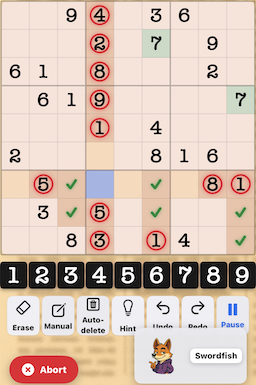
What is a Swordfish?
A Swordfish is an extension of the X-Wing pattern, using three rows and three columns instead of two. When a candidate appears in 2-3 cells in each of three rows, and all those cells fall within the same three columns, powerful eliminations become possible.
The pattern gets its name from the three-pronged shape it can form when visualised on the grid.
Swordfish vs X-Wing
X-Wing
2 rows × 2 columns
Exactly 2 cells per row
4 cells total (rectangle)
Swordfish
3 rows × 3 columns
2-3 cells per row
6-9 cells total (irregular)
The Flexibility of Swordfish
Unlike X-Wing which requires exactly 2 cells per row, Swordfish allows 2 OR 3 cells per row. This makes the pattern more flexible but also harder to spot. Valid configurations include:
- 3 + 3 + 3 = 9 cells (full Swordfish)
- 3 + 3 + 2 = 8 cells
- 3 + 2 + 2 = 7 cells
- 2 + 2 + 2 = 6 cells (minimal Swordfish)
How to Find Swordfish
Step-by-Step Process:
- Choose a candidate: Pick a number to search for
- Find restricted rows: Look for rows where the candidate appears in only 2-3 cells
- Check column alignment: Do three such rows share the same three columns?
- Verify the pattern: All candidate cells in these rows must fall within those three columns
- Make eliminations: Remove the candidate from other cells in those three columns
Why Swordfish Works
The Logic
Each of the three rows must have exactly one instance of the candidate. Since all possible positions fall within three columns, those three columns will receive exactly three instances of the candidate (one from each row).
Therefore, no other cell in those three columns can contain the candidate – they're already "claimed" by the Swordfish rows.
Example Analysis
Finding a Swordfish
Searching for candidate 4:
- Row 2: 4 appears in columns 1, 5, 8
- Row 5: 4 appears in columns 1, 8
- Row 8: 4 appears in columns 5, 8
Swordfish found! All cells fall within columns 1, 5, and 8.
Elimination: Remove 4 from all other cells in columns 1, 5, and 8.
Common Challenges
- Harder to visualise: The irregular shape makes Swordfish harder to spot than X-Wing
- More cells to track: You're managing 6-9 cells instead of 4
- Column alignment: All cells must fall within exactly three columns
- Partial rows: Rows with only 2 cells are valid but easy to overlook
Row-Based vs Column-Based
Like X-Wing, Swordfish can be found in two orientations:
Row-Based Swordfish
Start with 3 rows, eliminate from columns
Column-Based Swordfish
Start with 3 columns, eliminate from rows
Ready to Practice?
Download SudokuWorldTournament and master Swordfish patterns!
Download Free on App Store