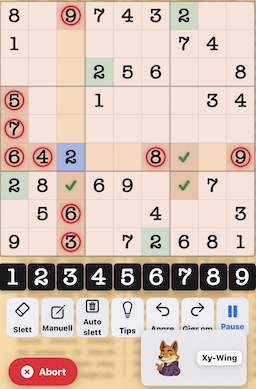
What is an XY-Wing?
An XY-Wing (also called Y-Wing) is a pattern involving three bi-value cells that creates a logical chain. The "pivot" cell sees two "wing" cells, and together they guarantee that a specific candidate can be eliminated from cells that see both wings.
It's called XY-Wing because the three cells contain candidates X, Y, and Z in a specific arrangement: {XY}, {XZ}, and {YZ}.
The Three Cells
Pivot Cell
Contains candidates {X, Y}
Sees both wing cells
The "hinge" of the pattern
Wing 1
Contains candidates {X, Z}
Sees the pivot cell
Shares X with pivot
Wing 2
Contains candidates {Y, Z}
Sees the pivot cell
Shares Y with pivot
Why XY-Wing Works
The Forcing Logic
The pivot cell must be either X or Y. Consider both cases:
- If pivot = X: Wing 1 {XZ} cannot be X, so it must be Z
- If pivot = Y: Wing 2 {YZ} cannot be Y, so it must be Z
Conclusion: Either Wing 1 or Wing 2 must be Z. Any cell that sees BOTH wings cannot be Z!
How to Find XY-Wings
Step-by-Step Process:
- Find bi-value cells: Identify all cells with exactly two candidates
- Choose a potential pivot: Pick a bi-value cell {XY}
- Find Wing 1: Look for a bi-value cell that sees the pivot and shares one candidate (X), with the form {XZ}
- Find Wing 2: Look for a bi-value cell that sees the pivot and shares the other candidate (Y), with the form {YZ}
- Verify Z is common: Both wings must share the same "Z" candidate
- Find elimination targets: Look for cells containing Z that see BOTH wings
- Eliminate Z: Remove Z from those target cells
Example Analysis
Finding an XY-Wing
- Pivot (R2C5): {3, 7}
- Wing 1 (R2C8): {3, 9} – shares 3 with pivot, in same row
- Wing 2 (R5C5): {7, 9} – shares 7 with pivot, in same column
XY-Wing found! Z = 9 (the common candidate in both wings)
Elimination: Remove 9 from any cell that sees both R2C8 AND R5C5.
Finding Elimination Targets
A cell can "see" another cell if they share a row, column, or box. For XY-Wing eliminations, the target cell must see BOTH wings simultaneously.
Common target locations:
- Cells in the same box as both wings
- Cells at the intersection of the wings' row and column
- Any cell that shares a unit with each wing
Common Mistakes
- Wrong pivot: The pivot must see BOTH wings directly
- Mismatched Z: Both wings must share the same third candidate
- Wrong eliminations: Only eliminate from cells that see BOTH wings, not just one
- Non-bi-value cells: All three cells must have exactly two candidates
XY-Wing Variations
The XY-Wing concept extends to more complex patterns:
- XYZ-Wing: Similar pattern where the pivot has three candidates
- W-Wing: Uses strong links instead of direct visibility
- Remote Pairs: Extended chains of bi-value cells
Ready to Practice?
Download SudokuWorldTournament and master XY-Wing patterns!
Download Free on App Store