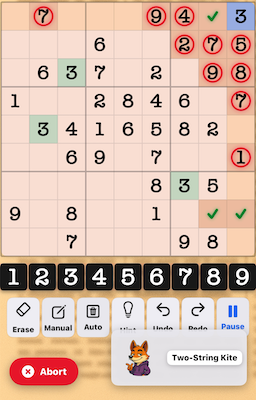
What is a Two-String Kite?
A Two-String Kite is a chain-based technique that uses two "strings" (strong links) – one in a row and one in a column – connected through a common box. The pattern resembles a kite shape when visualised on the grid.
This technique allows you to eliminate a candidate from a cell that sees the endpoints of both strings.
Understanding Strong Links
A strong link exists when a candidate appears in exactly two cells within a unit. If one cell doesn't have the candidate, the other MUST have it.
Row String
Candidate appears in exactly 2 cells in a row
Forms a strong link horizontally
Column String
Candidate appears in exactly 2 cells in a column
Forms a strong link vertically
The Kite Structure
Four Key Cells
- Cell A: One end of the row string (outside the connecting box)
- Cell B: Other end of the row string (inside the connecting box)
- Cell C: One end of the column string (inside the connecting box, same box as B)
- Cell D: Other end of the column string (outside the connecting box)
Cells B and C are in the same box, connecting the two strings.
Why Two-String Kite Works
The Logic Chain
Consider what happens if Cell A doesn't have the candidate:
- If A is NOT the candidate → B MUST be (row strong link)
- If B is the candidate → C is NOT (same box)
- If C is NOT the candidate → D MUST be (column strong link)
Conclusion: Either A or D must have the candidate. Any cell that sees BOTH A and D cannot have it!
How to Find Two-String Kites
Step-by-Step Process:
- Choose a candidate: Pick a number to search for
- Find row strong links: Look for rows where the candidate appears in exactly 2 cells
- Find column strong links: Look for columns where the candidate appears in exactly 2 cells
- Check for box connections: Do any row and column strings share a box?
- Identify the kite: The strings must connect through cells in the same box
- Find elimination targets: Look for cells that see both outer endpoints (A and D)
- Eliminate: Remove the candidate from target cells
Example Analysis
Finding a Two-String Kite
Searching for candidate 5:
- Row 2: 5 appears only in C2 and C8 (strong link)
- Column 3: 5 appears only in R2 and R7 (strong link)
- Connection: R2C3 is in Box 1, connecting both strings
Kite structure:
- A = R2C8 (row endpoint outside box)
- B = R2C3 (row endpoint inside box)
- C = R2C3 (column endpoint inside box – same cell as B!)
- D = R7C3 (column endpoint outside box)
Elimination: Remove 5 from any cell that sees both R2C8 and R7C3.
Common Patterns
- Shared cell: Often, cells B and C are the same cell (the strings share an endpoint)
- Different cells: Sometimes B and C are different cells in the same box
- Target location: The elimination target is typically at the intersection of A's row/column and D's row/column
Related Techniques
Skyscraper
Two parallel strong links (both rows or both columns) with one shared endpoint
Turbot Fish
General term for patterns using strong links in different orientations
Ready to Practice?
Download SudokuWorldTournament and master Two-String Kite patterns!
Download Free on App Store